
Makgadikgadi Pans National Park
Ancient lakebed turned vast salt pans — home to Africa's second-largest zebra migration and surreal desert landscapes
country
Botswana
size
12,000 km² (combined with Nxai Pan)
best season
November to March (Green Season for migration)
famous for
Massive zebra migration & Kubu Island baobabs
The Remnants of an Ancient Super-Lake
The Makgadikgadi Pans are what remains of an enormous paleo-lake that once covered around 60,000 square kilometers of central Botswana during the Pleistocene epoch. Fed by the Okavango, Chobe, and Zambezi rivers, this ancient lake began to dry up around 10,000 years ago when tectonic shifts diverted its water sources. Today, the salt crust extends up to five meters deep in places — the largest continuous salt pan complex on Earth.
Ntwetwe Pan & Sowa Pan: Giants of Salt
The park encompasses two principal pans: Ntwetwe Pan, which stretches approximately 120 kilometers east to west and 160 kilometers northeast to southwest, and the smaller Sowa Pan, roughly 70 by 110 kilometers. Together they form an otherworldly expanse so vast that the curvature of the Earth becomes visible on the horizon. In the dry season, the cracked white surface creates a landscape often described as lunar or Martian.
Africa's Hidden Migration
While the Serengeti wildebeest migration captures the global spotlight, Makgadikgadi hosts one of Africa's most dramatic wildlife spectacles largely unseen by crowds. As the rains begin in November, an estimated 25,000–30,000 zebra and wildebeest move from the Boteti River area onto the pans. This is the second-largest zebra migration on the continent. The herds are followed by lions, cheetahs, and the critically important brown hyena, creating a full predator-prey drama across the shimmering grasslands.
Desert-Adapted Wildlife & Rare Species
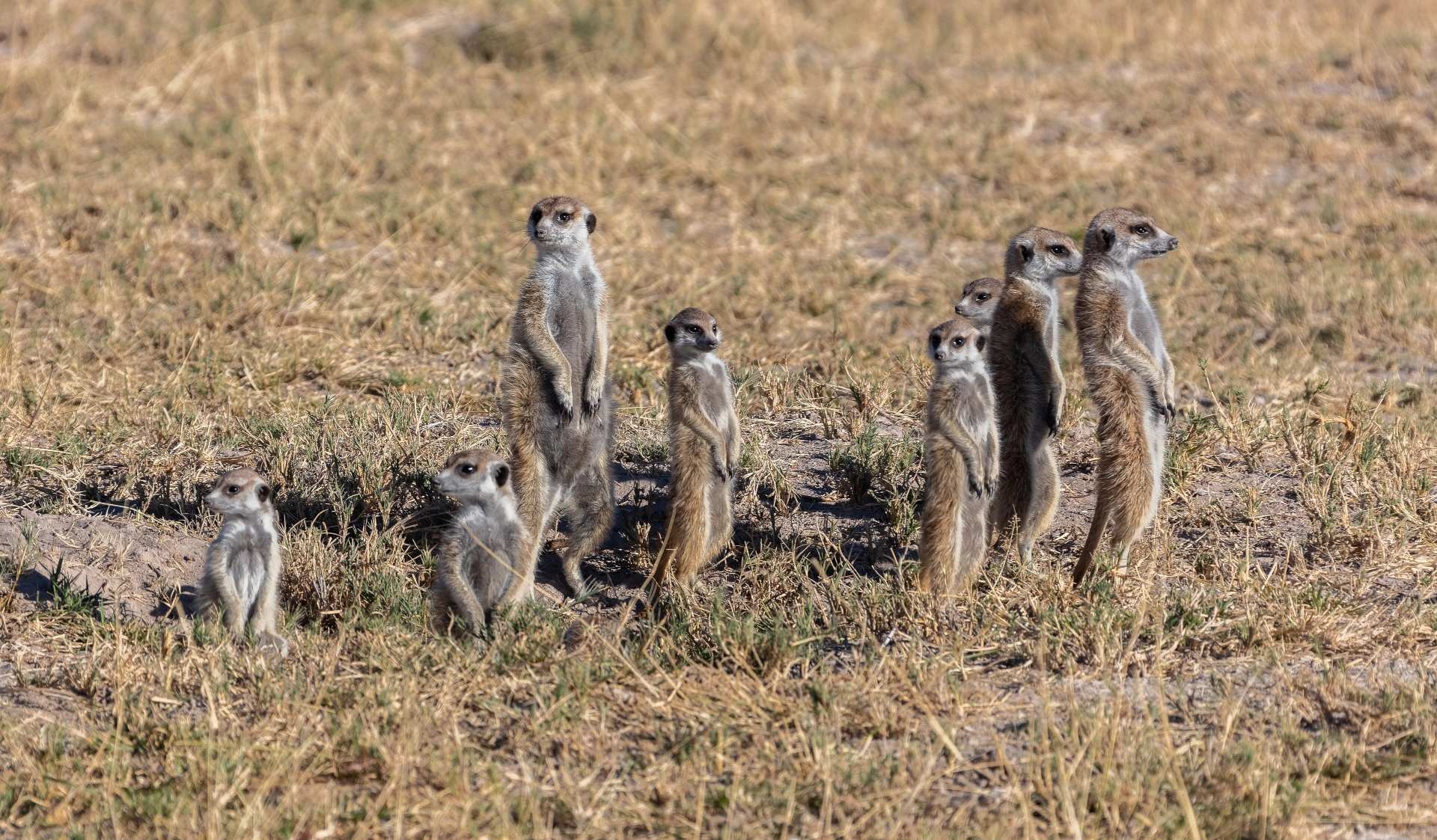
Survival in this extreme environment demands remarkable adaptations. Brown hyenas — one of Africa's rarest large carnivores — thrive here alongside aardvarks that emerge at night to dig for termites. Bat-eared foxes, springbok, gemsbok, and the charismatic meerkat are common sightings. After sufficient rains, the shallow pans become breeding grounds for enormous flocks of greater and lesser flamingos, sometimes numbering over 30,000 birds that fly in from as far as East Africa.
Kubu Island: The Sacred Rock of Baobabs
Rising mysteriously from the flat expanse of Sowa Pan, Kubu Island is a granite outcrop dotted with ancient baobab trees and adorned with fossilized guano from centuries of bird colonies. This site holds deep spiritual significance for the indigenous San and Kgalagadi people, who considered it a sacred place. Stone-age tools and artifacts scattered across its slopes testify to human presence dating back thousands of years. Today, camping on Kubu Island under a blanket of unpolluted stars is considered one of Africa's most magical wilderness experiences.
The Boteti River: A Lifeline in the Dry
On the park's western boundary, the Boteti River serves as the primary water source during the dry season months. When the interior pans dry out completely, wildlife congregates dramatically along this ribbon of green. Large herds of elephant, giraffe, kudu, zebra, and wildebeest line the riverbanks, making it one of Botswana's finest — yet still overlooked — game-viewing corridors. The river is fed by overflow from the Okavango Delta, linking two of Botswana's most important ecosystems.
Walking with the San: Ancient Knowledge
The Makgadikgadi region is part of the ancestral territory of the San (Bushmen) people, who have navigated and survived this harsh landscape for millennia. Several lodges and camps offer cultural walks led by San trackers, who demonstrate ancient skills: identifying edible plants, reading animal tracks in the salt, finding underground water sources, and sharing stories passed down through countless generations. These encounters provide a rare and respectful window into one of humanity's oldest continuous cultures.
Makgadikgadi Biodiversity
Discover Flora and Fauna
Mammals
Zebra, Wildebeest, Springbok, Gemsbok
Predators
Lion, Cheetah, Brown Hyena, Spotted Hyena
Small Mammals
Meerkats, Aardvarks, Bat-eared Foxes
Birds
Greater & Lesser Flamingos, Pelicans, Ostrich
Flora
Camel thorn, Tsamma melons, Salt-tolerant grasses
Insects
Brine shrimp, Termites
Climate & Best Time to Visit
When is the best time to visit?
Makgadikgadi transforms completely with the seasons. During the rains, the pans become a vital grassland for migrating herds. In the dry months, they turn into a stark, shimmering white desert ideal for adventure activities.
Jan
Feb
Mar
Apr
May
Jun
Jul
Aug
Sep
Oct
Nov
Dec
Excellent
Good
Low